
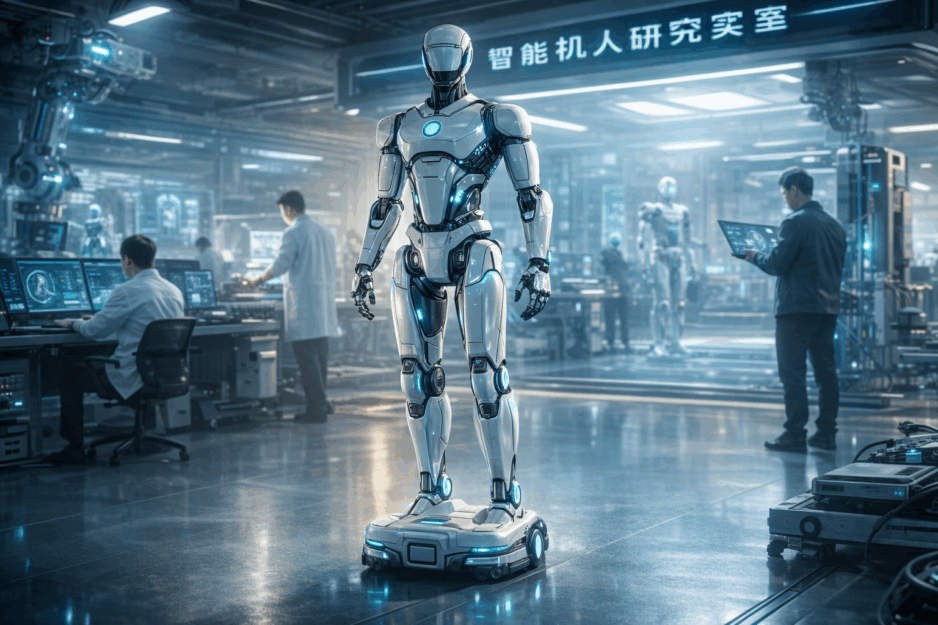
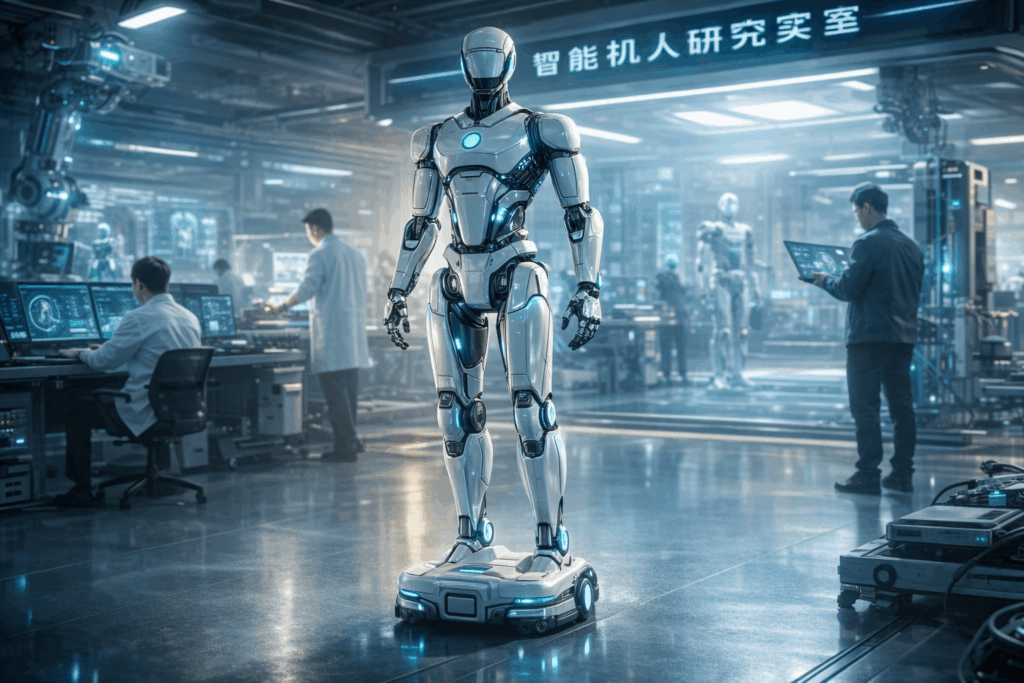
For months, Elon Musk has been telling investors that the Tesla Optimus could revolutionize the global economy and create an entirely new mega-industry. Yet Musk has also repeatedly warned that the largest share of this emerging market could ultimately belong to China.
“China is an ass kicker, next level,” Musk said in January. “To the best of our knowledge, we don’t see any significant humanoid-robot competitors outside of China.”
A Rapidly Expanding Industry
China is moving quickly to position itself as the global leader in humanoid robotics. Startups and robotics companies are emerging across the country—from Shenzhen to Suzhou—with more than 140 firms now developing humanoid robots.
Leveraging an extensive network of parts suppliers and a deep pool of engineering talent, Chinese companies are beginning to scale up production and test humanoid robots in real-world environments. These machines are already appearing in factories, hotels, and office buildings, where they assist with logistics, customer interaction, and routine tasks.
Behind this rapid expansion is a strong push from Beijing. The Chinese government has identified “embodied AI”—the integration of artificial intelligence with physical robotic systems—as a strategic technology it aims to dominate within the next five years.
Massive Government Support
Government backing is playing a central role in accelerating the industry. Local authorities are offering companies land, discounted office space, and financial incentives, while banks are providing favorable loan terms.
Since late 2024, major cities including Beijing and Shenzhen have created investment funds totaling more than $26 billion to support humanoid-robot development, according to estimates from Morgan Stanley.
State institutions are also helping build an early market. Government agencies and state-owned enterprises are purchasing humanoid robots and deploying them in public spaces such as museums and events. Some robots have even appeared on city streets acting as “robocops,” assisting with traffic management.
These early deployments serve two important purposes: they help companies generate revenue while also collecting valuable operational data that can improve the robots’ performance.
To encourage adoption, some local governments are subsidizing purchases by covering around 10% of the cost of humanoid robots.
A Familiar Industrial Strategy
China’s approach mirrors the strategy it previously used to build other advanced industries, particularly electric vehicles.
Over the past decade, government incentives for buyers and manufacturers helped China develop one of the world’s most competitive EV sectors. Chinese automakers now dominate the domestic market and are rapidly expanding overseas, challenging established brands such as General Motors and Volkswagen in markets across China, Europe, and beyond.
According to Sunny Cheung, China is applying a similar formula to humanoid robotics.
“China is once again mobilizing state support, supply-chain depth, and rapid commercialization to build a new strategic sector,” he said.
However, the ultimate winner will likely depend on who can solve the complex technical challenges involved in building capable humanoid robots.
Early Days—and Plenty of Skepticism
Despite the momentum, the humanoid-robot industry remains in its infancy. It could take many years before robots become widely deployed—if they do at all.
Some skeptics argue that humanoid robots may be little more than a technology bubble, questioning whether they will ever find practical and economically viable use cases.
China’s push has also been accompanied by considerable hype. A recent 13-mile humanoid robot marathon showcased both the promise and the limitations of the technology. One robot managed to finish the race in under three hours—with human assistance—while several others stopped mid-course or refused to move altogether.
Growing Concern in the United States
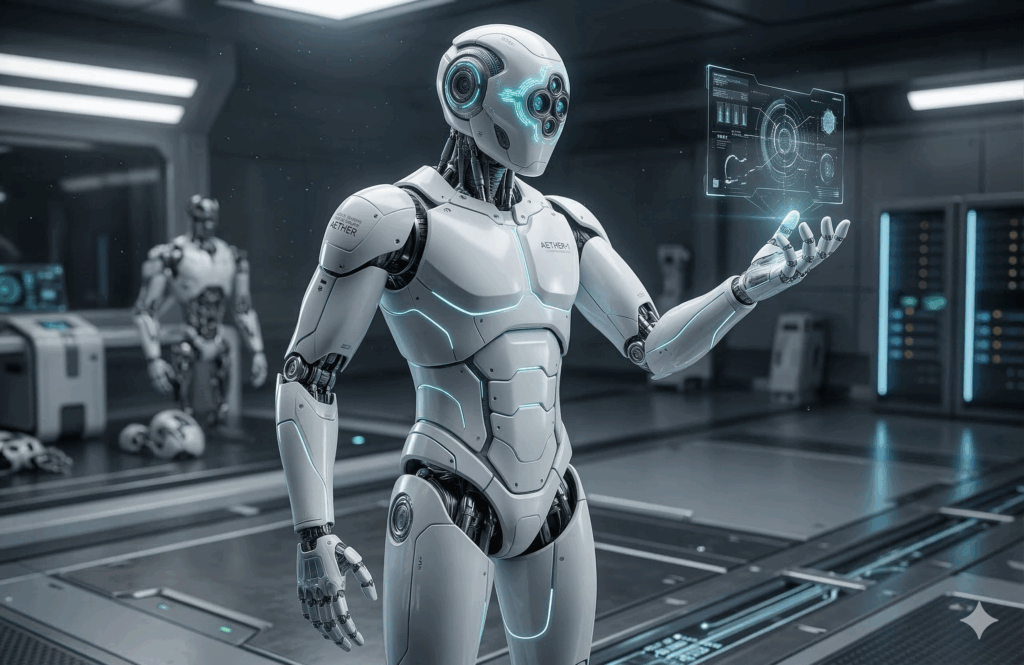
Even so, China’s rapid progress is raising concerns among policymakers and technology leaders in the United States. The White House is reportedly working on an executive order aimed at strengthening the American robotics industry.
One major concern is the possibility that U.S. robotics companies could become dependent on China’s manufacturing ecosystem. Even Tesla’s Optimus robot is expected to rely on Chinese suppliers for key components such as roller screws. As the race to build advanced humanoid robots intensifies, the competition may ultimately hinge not only on technological breakthroughs—but also on control of global supply chains and industrial scale.
Karlheinz Zuerl
The System Doctor for your Profit Growth in Europe and BRICS+ countries
CEO of GTEC (German Technology and Engineering Cooperation)
Co-Partner of BRICS Project Network
Book Author

Where we speak in public:
https://leanbase.de/latc/speakers/2026-karlheinz-zuerl
CLICK here to see more Ai articles.
Experts in the Automotive Industry Asia
You need one, but don`t want to hire one permanently?
Our solution: To rent our experts
- On pay-to-use basis
- Completely flexible
- Contract can be cancelled any time
Clearly represented reports and dashboards inclusive!