Lean production is a management philosophy focused on maximizing customer value by systematically eliminating waste (“muda”) and reducing inefficiencies throughout the entire production process.
Originating from the Toyota Production System, it emphasizes continuous improvement (Kaizen), high-quality standards, reduced inventory, and just-in-time delivery to increase efficiency and responsiveness.
Key aspects of using LEANFLOW AI approach:
Waste Elimination: Targets 8 types of waste: defects, overproduction, waiting, unused talent, transportation, inventory, motion, and extra-processing.
Value Addition: Focuses solely on actions that add value from the customer’s perspective.
Continuous Improvement (Kaizen): A long-term approach where all employees seek small, incremental improvements to processes.
Core Methodologies: Utilizes tools like Just-in-Time (JIT), 5S (Sort, Set in order, Shine, Standardize, Sustain), Kanban, and Value Stream Mapping (VSM).
Core Principles: Defines value, maps the value stream, creates flow, establishes pull systems, and seeks perfection.
A digital twin is a dynamic virtual representation of a process or system that acts as its real-time digital counterpart.
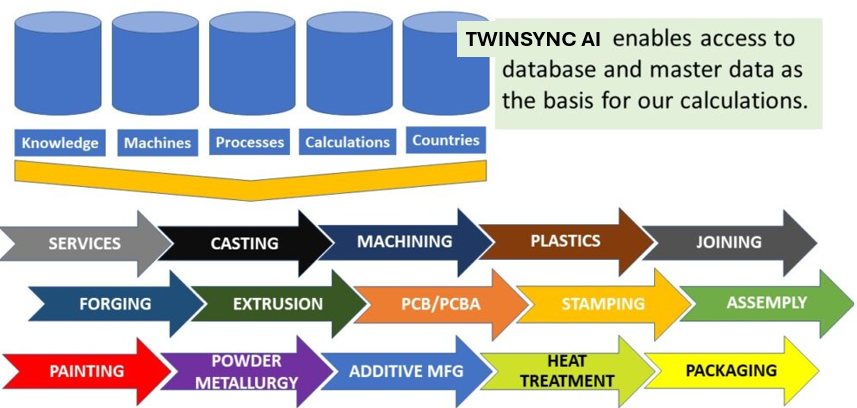
The primary purpose of TWIN SYNC AI is to leverage data to enhance, predict, and optimize, often calculate manufacturing costs, purchasing costs, define real sales prices, reduce maintenance costs, and increase operational efficiency.
TWIN SYNC AI is a System/Process Twin: It is modelling complex systems, such as a factory or an entire supply chain.
With our TWIN SYNC AI, you can simulate & analyze: Users can run simulations to test scenarios (e.g., “what-if” analyses) without interrupting real-world operations, reducing risks and costs.
You’ll have the following advantages using TwinSync AI:
Savings in business process cost reduction
Build up a learning organization with supply-chain-related training and workshops
Savings in relocations/ increase localization content (if possible)
Savings in the purchasing of raw material
Savings in logistics (bundling, transportation)
Savings from pooling with your company plants or external partners
Savings from contracts
Savings in non-production material
Cost control
Karlheinz Zuerl
The System Doctor for your Profit Growth in BRICS+ countries
Partner of ESG-Lotsen.com (PM, Interim Management Service)
Partner of BRICS+ Project Network (PM, Interim Management Provider Service)
CEO of GTEC (German Technology & Engineering Cooperation) with GTEC Profit Growth Academy and GTEC-Shop
Office Hongkong: Kowloon (Cell: +86 13482438080)
Office Thailand: Chiang Mai (Cell: +66 636780790)
Partner offices are in Can Tho (Vietnam), Bangalore (India), Dubai (UAE), Moscow (Russia), São Paulo (Brazil), and Shenzhen (China).
Supply chain teams spend 30-60 minutes per complex query searching multiple systems for product specs, pricing, shipping rates, and compliance info. With 10+ queries daily, this creates bottlenecks, slow customer responses, and employee frustration doing repetitive work.
2. THE SOLUTION
AI answers complex queries in 2-3 minutes, including product availability, pricing calculations, shipping options, and compliance checks – all with source citations. Demo video shows the real system answering a multi-part question about product fulfillment to France with a complete cost breakdown and regulatory requirements.
3. BUSINESS IMPACT
For a team handling 10 queries daily, AI saves 6-7 hours per day (freed capacity for strategic work). Implementation costs are low with positive ROI typically within 3-6 months, plus competitive advantages from faster customer response times.
4. SECURITY & DATA PRIVACY
Data is encrypted at rest and in transit with multiple deployment options: cloud (fast, certified security), hybrid (data on-premises), or full on-premises (maximum control). Major cloud providers have dedicated security teams and certifications that most companies can’t match in-house.
5. GRADUAL IMPLEMENTATION
Start with a 4–6-week pilot (one department, limited documents, 3-5 users) to prove value with measurable results. Only expand to Phase 2 if pilot is successful – no “big bang” disruption, clear decision points at each phase.
6. MARKET CONTEXT
AI adoption in the supply chain is growing as technology matures and companies see real operational benefits. Early adopters gain competitive advantages through faster response times and better service quality.
7. NEXT STEPS
Free 30-minute consultation to discuss specific needs, followed by a custom pilot proposal if interested. Pilot includes clear success metrics and a decision point after 4-6 weeks – scale if successful or end if not meeting goals.
Key Messages Throughout
Challenge: Significant time spent on repetitive information hunting
Solution: AI answers complex queries in seconds with verification
Practical: Faster response, more capacity, better service
Secure: Multiple deployment options for different needs
Low risk: Prove value in pilot before committing
Timely: Technology maturing, early advantages available
Karlheinz Zuerl
The System Doctor for your Profit Growth in BRICS+ countries
Partner of ESG-Lotsen.com (PM, Interim Management Service)
Partner of BRICS+ Project Network (PM, Interim Management Provider Service)
CEO of GTEC (German Technology & Engineering Cooperation) with GTEC Profit Growth Academy and GTEC-Shop
Office Hongkong: Kowloon (Cell: +86 13482438080)
Office Thailand: Chiang Mai (Cell: +66 636780790)
Partner offices are in Can Tho (Vietnam), Bangalore (India), Dubai (UAE), Moscow (Russia), São Paulo (Brazil), and Shenzhen (China).
GTEC has restructured and diversified its revenue streams this year.
Through our partnership with the BRICS Project Network, we have gained new experts from different countries and brought the four pillars of our network to life. In particular, our investments in several start-ups in the fintech and entertainment sectors have proved highly profitable. In the product sector, we distribute ‘Microdots’ for the automotive and mechanical engineering industries (see https://gtec.asia/technical-service-in-industry/datadotdna/) and have developed the first AI product for the supply chain (software) and a second for the healthcare sector (hardware).
Our webinar on January 15 will explain the importance and efficiency for purchasing departments.
Additionally, I rent out my address in Thailand to companies and freelancers looking for an address, a bedroom, workspaces, and a conference table for additional employees, all with fast internet. My partners in Dubai, Hong Kong, Suzhou, and Shenzhen offer the same services. By 2026, we will have created a network of business centers and co-working spaces that SMEs can use as remote workplaces.
Together with Friedhelm Best from Singapore, the new member of the BRICS Project Network,, we published the book/e-book “The Rise of BRICS in Artificial Intelligence: How AI Will Change the World” in early December 2025.
Our partners in the BRICS Project Network enjoy preferential rates across all areas. For example, they receive significant discounts on our products, services, AI tools, books, and business centers.
As 2025 comes to a close, I would like to thank all our customers and business partners for their excellent and constructive cooperation. May you find peace and relaxation between the years, and all the best in the new year of 2026!
I am looking forward to what the new year will bring. How did 2025 treat you? I look forward to hearing from you.
Best regards Karlheinz Zuerl
The System Doctor for your Profit Growth in BRICS+ countries
Office Hongkong: Kowloon (Cell: +86 13482438080)
Office Thailand: Chiang Mai (Cell: +66 636780790)
Partner offices are in Can Tho (Vietnam), Bangalore (India), Dubai (UAE), Moscow (Russia), São Paulo (Brazil), and Shenzhen (China).
A Comprehensive Certification Program for Foreign Businesses in Europe
The European Union’s Artificial Intelligence Act (EU AI Act), effective August 1, 2024, represents a significant regulatory shift for businesses using artificial intelligence (AI) within the EU. This landmark legislation introduces stringent compliance requirements, impacting how companies develop, deploy, and govern AI systems. For businesses operating in or entering the European market, understanding and adapting to these regulations is not just a necessity—it is a competitive imperative.
The **Certified Expert on the EU AI Act Program**, led by Steinbeis Augsburg Business School, offers a specialized training solution tailored for professionals. This program provides in-depth knowledge of the EU AI Act, practical tools for compliance, and strategies to ensure AI is implemented ethically and responsibly, with full simultaneous Chinese translation for seamless participation.
Six Key Challenges and Opportunities Under the EU AI Act
**1. Financial Impacts on BRICS+ Businesses
Adhering to the EU AI Act introduces significant costs for companies coming from BRICS countries. For instance, Hong Kong-based AI startup Dayta AI projects cost increases of 20% to 40%, primarily due to stricter data quality and representativeness requirements. These added costs necessitate careful selection of training data and a re-evaluation of existing AI workflows.
**2. Competitiveness in the European Market**
While compliance ensures access to the lucrative EU market, the regulatory burden poses competitiveness challenges. Unlike the relatively unregulated AI markets in the US and China, the EU’s stringent rules require significant adaptation. However, companies that achieve compliance can gain trust and a competitive edge in the European landscape.
**3. Specific Requirements for AI Systems**
The EU AI Act categorizes AI systems into three risk tiers:
– **Prohibited Systems**: Includes AI used for social scoring, banned for its ethical and privacy concerns.
– **High-Risk Systems**: Subject to rigorous requirements, including risk management, transparency, and compliance certification.
– **Low-Risk Systems**: These require minimal oversight but must meet basic transparency guidelines.
Understanding these categories is critical for businesses to align their operations with EU standards.
**4. Compliance Timelines and Transition Periods**
The phased rollout of the EU AI Act gives businesses time to adapt, with key milestones such as:
– Prohibition of certain AI practices and enforcement of general provisions.
– Introduction of Codes of Practice to assist early adopters.
Full compliance is expected by 2030, requiring companies to prepare now for a smooth transition.
**5. Risks of Non-Compliance**
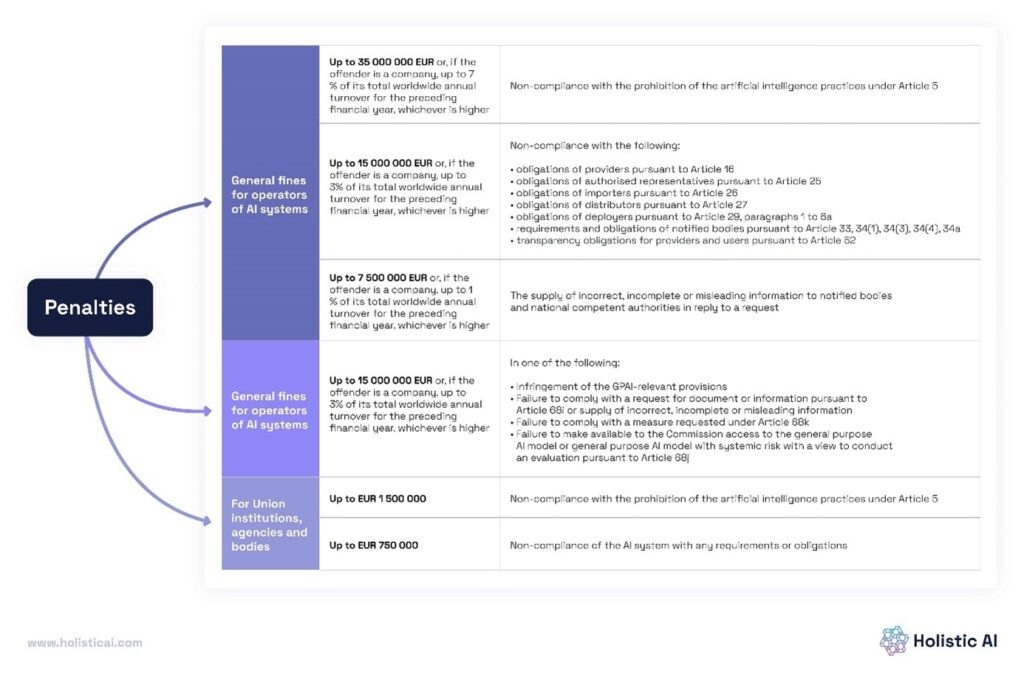
Penalties for non-compliance are severe, including fines of up to €30 million or 6% of global annual revenue, whichever is greater. These strict penalties underscore the need for rigorous adherence to the regulations.
**6. Steps for Ensuring Compliance**
BRICS+ businesses can prepare for the EU AI Act by:
– **Conducting Risk Assessments**: Classify AI systems based on risk tiers.
– **Enhancing Transparency**: Ensure systems are explainable to users.
– **Improving Data Quality**: Meet EU standards for training data.
– **Maintaining Documentation**: Keep detailed records of AI development and deployment.
Why This Program is Essential for AI Professionals
The **Certified Expert on the EU AI Act Program** addresses these challenges by offering a comprehensive curriculum designed to equip participants with the expertise to navigate the complexities of the regulation.
Program Benefits
Master the legal framework and requirements of the EU AI Act.
Learn to implement AI responsibly, ensuring ethical and societal considerations are met.
Develop strategies to align AI systems with European compliance standards.
Gain practical tools to conduct risk assessments, enhance transparency, and manage data security.
Program Content
1. AI in Everyday Business
Understand how to integrate AI effectively to improve efficiency, enhance quality, and streamline decision-making processes.
2. The EU AI Act
Gain a thorough understanding of the Act’s legal provisions, including its risk-based approach and compliance obligations.
3. Risk Analysis and Data Protection
Learn to identify and evaluate risks associated with AI systems, while ensuring compliance with data protection standards.
4. Ethical AI Implementation
Explore strategies for embedding ethical principles into AI development and deployment, addressing societal and moral impacts.
5. Compliance and Certification
Prepare for the EU AI Act certification by implementing governance structures and maintaining proper documentation.
Four Program Highlights
1. **Tailored for Chinese Businesses**
Specifically designed for Chinese companies operating in or expanding to Europe, addressing unique challenges and opportunities.
2. **Multilingual Accessibility**
Delivered with simultaneous Chinese translation, ensuring participants were fully engaged with the content.
3. **Expert-Led Training**
Gain insights from leading European AI and legal experts, blending academic rigor with practical applications.
4. **Global Networking Opportunities**
Connect with like-minded professionals across industries and regions, fostering collaborative growth.
Who Should Attend?
Chinese business leaders navigating AI compliance in Europe.
Legal and compliance professionals ensuring organizational alignment with the EU AI Act.
AI developers and technology specialists seeking to enhance their understanding of regulatory frameworks.
Your Path to Compliance and Success
With the EU AI Act transforming how AI is governed, businesses must act decisively to align with these new standards. By joining the **Certified Expert on the EU AI Act Program**, you’ll position yourself and your organization as leaders in ethical, responsible, and compliant AI usage.
Program Overview
Module 1 (Suzhou, China): AI in Everyday Business Understand how to integrate AI effectively to improve efficiency, enhance quality, and streamline decision-making processes.
Module 2 (Suzhou, China): The EU AI Act Gain a thorough understanding of the Act’s legal provisions, including its risk-based approach and compliance obligations.
Module 3 (Suzhou, China): Risk Analysis and Data Protection
Learn to identify and evaluate risks associated with AI systems, while ensuring compliance with data protection standards.
Module 4 (Hamburg, Germany): Ethical AI Implementation
Explore strategies for embedding ethical principles into AI development and deployment, addressing societal and moral impacts.
Module 5 (Hamburg, Germany): Compliance and Certification
Prepare for the EU AI Act certification by implementing governance structures and maintaining proper documentation.
Examination (Hamburg, Germany): Final exam of modules 1 to 5 and presentation of certificates (ceremony) with press.
Each module includes case studies, interactive workshops, and opportunities for peer learning, ensuring you gain both theoretical and practical insights.
Program Overview
Purpose of the Program This certification develops AI Act experts capable of driving sustainable strategies, measuring performance, and ensuring compliance with key regulations.
Learning Format The program is structured around five intensive modules, combining online live sessions and on-site workshops in Suzhou, China (three modules), and Hamburg, Germany (three modules). This enables participants to gain a global and localized perspective on AI Act practices.
Expert Instruction with Global Accessibility All sessions are led by industry-leading European experts and practitioners, with simultaneous English and Chinese translation to ensure seamless engagement and understanding.
Who should attend:
CEOs, CFOs, COOs, and other C-level executives who want to sell their products to Europe. Either by shipping directly to the European customer or by selling the products to suppliers.
The key is to:
a. Provide the relevant evidence in the AI Act on time.
b. Avoid the horrendous contractual penalties caused by errors in the documentation.
Benefits:
Obtain and sustain orders
Establish a professional network at the same level with potential customers and suppliers in Europe and the BRICS countries.
(2) Executives or management consultants, who want to professionally prepare their entry or transition into an AI management role.
Benefits:
Be faster to market and receive appropriate project requests and assignments.
Avoid trial and error and costly loss of time.
Gain security by creating a concrete “plan” together with industry experts; also integrating it into a network.
(3) People already working as interim managers, who want to “fine-tune” their business model and market development considering current market changes.
Benefits:
More suitable project requests
Better utilization at the right daily rate
More fun at work – Integration of expert tips into one’s own work
Integration into a network
The mix of participants from all countries is a very “stimulating” mix for everyone.
Program Goals and Outcomes: What You Will Achieve
1. Expertise in AI ACT Standards and Practices:
Deep understanding of AI ACT.
Knowledge of cutting-edge methods to measure and manage AI ACT performance.
Ability to prepare sustainability reports aligned with global standards.
Awareness of the latest developments in AI ACT regulations and reporting frameworks.
2. Practical Skills for Immediate Application:
Crafting sustainable corporate strategies and integrating AI goals.
Identifying and managing AI risks and leveraging opportunities for innovation.
Communicating AI initiatives effectively to internal and external stakeholders.
Advising companies on meeting AI ACT requirements.
3. Leadership and Influencers:
Position yourself as a sought-after AI ACT consultant in an increasingly sustainability-driven global economy.
Build a network of like-minded professionals and industry leaders.
Concrete steps to implement this personal business plan
Your business model and personal business plan
Your career plan with concrete steps
Clarity about “My core competencies and what I like to do”
Network with practical tips from experienced industry insiders
Reflection with practical tips from experienced industry insiders
Network for further support along the way (individual peer-to-peer mentoring and access to the Master of Excellence network)
Master of Excellence in AI ACT certificate from a renowned global think tank
Individual follow-up coaching by the speakers and mentors (dates to be agreed upon individually)
What Sets This Program Apart
Focus on Businesses in Europe for BRICS+ countries Tailored for Chinese companies expanding into Europe, this program addresses the unique challenges and opportunities faced by professionals, including regulatory compliance and sustainable growth strategies.
Global Learning with Local Context Gain exposure to European AI ACT leadership while understanding its relevance to the Chinese business environment.
Cutting-Edge Content Dive into AI ACT topics such as carbon reduction, energy efficiency, sustainable supply chains, and innovative governance models.
Networking Opportunities Build a robust network of Chinese and European business leaders, creating opportunities for collaboration and growth.
A Basic Conviction that Guides You Through the Course
Leaders are successful:
… when they do what they enjoy and find “meaningful”
… when they do what they are “really good at” – and better than their “competition”
… when they offer their customers added value with what they do
… when they are “entrepreneurs” for themselves
… when you can market and monetize your offering, i.e. the market rewards your service at an appropriate price.
All five conditions should be met for sustainable success.
Procedure
Before the course
Check if it makes sense to participate and register. Upon request: Non-binding preliminary discussion (video call) with Andreas Renner from Steinbeis Business School Hamburg Germany, Dr. Lucas Bretz from GAMI Suzhou China in English or German.
Binding registration of participants HERE
Preparation of participants for the face-to-face part. Participants will receive a preparation assignment in advance (time commitment 1/2 day).
Individual development of a business model/business plan integrated into your life concept or your own company.
Documents and instructions will be presented and explained in the classroom.
Examination
Online presentation of the business model/business plan by the participants plus feedback/discussion (60 minutes per participant). Online on 2 different dates of your choice.
Certification upon completion of requirements.
After passing the exam: Coaching, mentoring and networking
Coaching of the practical implementation of the participants by the workshop leaders (one meeting per participant with an instructor).
Mentoring by interim manager peers (by mutual agreement)
Inclusion in the LinkedIn group (Certified AI ACT Consultants network)
Dates and Schedule AI-Act
Modules 1 & 2 & 3: Suzhou, China – November 4-5, 2025
Modules 4 & 5: Hamburg, Germany – November 18-19, 2025
Exam: Hamburg, Germany – November 20, 2025
Start at 9 am. End at 5 pm.
Program Outcomes
Upon completion, you will:
Earn a recognized certification as a Certified AI ACT Consultant, a distinction that sets you apart in the global market.
Be equipped to assist companies in overcoming ESG challenges, ensuring compliance, and driving sustainability initiatives.
Possess a unique blend of global insights and local expertise, making you a valuable asset to any organization.
Certification, Certificate, and Seal
Examination: Preparation and presentation of a business plan based on anindividual career plan: Written through submission to instructors and successful online presentation with questions answered and discussion.
Lecturer certificate: The certificate is awarded by the Future Academy of the global think tank Diplomatic Council (UN reg.) together with UNITEDINTERIM.
Seal: Each participant will receive a “Master of Excellence in AI ACT” seal, jointly awarded by GTEC and Steinbeis Business School. The seal is perfect for self-promotion (website, email signature, social media…).
Take the First Step Toward Sustainability Leadership
Join the Certified AI ACT Consultant Program and empower your business to thrive in a sustainability-driven world. Whether you are a leader aiming to elevate your organization’s AI performance or an entrepreneur seeking a competitive edge, this program is your gateway to success.
Visit our website at steinbeis-ifem.de for more information and registration.Together, let’s build a sustainable future.
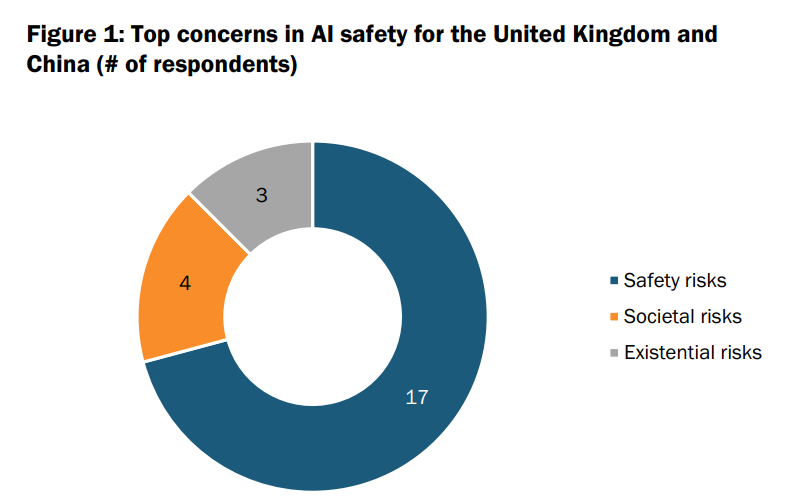
Experts have outlined their main concerns about AI safety, focusing on three major areas: safety risks, societal risks, and existential risks. When asked, “What worries you most about AI safety?” they pointed to various challenges.
Safety risks include the creation of AI systems that are unsafe, inaccurate, unreliable, or fail in unexpected situations. Both U.K. and Chinese experts raised concerns about AI systems not aligned with human goals or values, as well as the dangers of human-AI interactions, such as robots causing harm or accidents with self-driving cars.
Societal risks involve issues like AI misuse, such as the creation of deepfakes for fraudulent purposes. U.K. experts emphasized ethical concerns, particularly regarding AI’s impact on children and the risk of job displacement leading to high unemployment. They highlighted the need to address these issues to prevent social disruption.
Existential risks were a primary focus for some Chinese experts, who stressed the potential threats posed by advanced AI systems, including weaponization. They noted that AI’s rapid development could lead to significant and possibly irreversible global consequences.
It’s clear that addressing AI safety is essential to mitigate potential harm on a societal and global scale.
Experts in the Automotive Industry Asia
You need one, but don`t want to hire one permanently?
GTEC German Technology and Engineering Asia Business Outlook enables business leaders to make informed decisions and stay ahead of the competition. Its readers gain first-hand insights into emerging market trends, disruptive technologies, regulatory developments and investment opportunities across Asia.
GTEC also showcases success stories from leading companies in the region, highlighting their journey to success, profit and wealth. CEO Karlheinz Zuerl also provides exclusive articles on Asian countries, offering a panoramic view of strategies in the respective sectors.
“As a leading provider of interim management and experts in Asia, GTEC and its team need to stay ahead of industry applications in order to provide excellent service to its clients. Therefore, attending exhibitions and congresses is a must to get in touch with other companies and their leaders to learn what they are offering in the market,” said Karlheinz Zuerl.
Today’s press release is aimed at C-level executives attending the Future Energy Asia conference in Bangkok, May 15-17.
“We offer a wealth of expert analysis that enables readers to make informed decisions, seize opportunities and thrive in the ever-evolving Asian market,” summarizes Karlheinz Zuerl.
Future Energy Asia focuses on low-carbon societies and decarbonized energy ecosystems. The Asia-Pacific region is the world’s largest energy market, already accounting for nearly 50% of global energy consumption. With projections for rapid economic and population growth in the coming decades, the world is seeking to meet the critical goals of low carbon footprint and decarbonization.
For example, STRATEGICS EXPERTS from Malaysia and Bharat Petroleum Corporation Limited from India.
1. About STRATEGICS EXPERTS
Founder and CEO L. Shaktivell said: “We are committed to transforming industries through innovation and sustainability. For example, in Gas & Oil, our Fiber Comp. is revolutionizing maintenance practices for piping systems through Smart AI Predictive Maintenance and Composite Wrapper technology”.
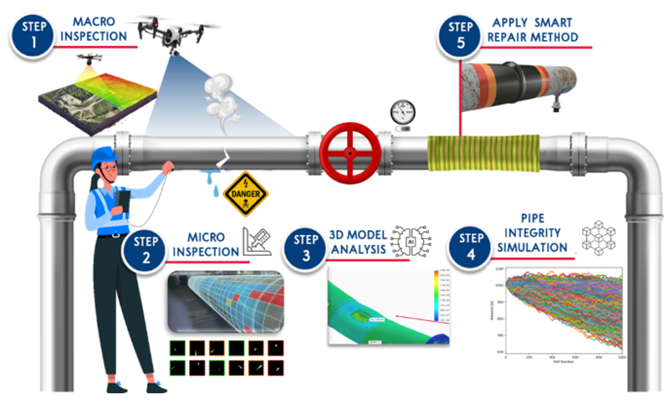
61% of pipe leaks are caused by corrosion, resulting in $30 billion in lost revenue annually. Currently, when a pipe leaks, there is an emergency shutdown and the pipeline needs to be closed and repaired. Their solution has the following steps:
Macro inspection by drones, send data to base station. Monitored by cloud computing.
Micro inspection
3D model analysis
Pipe integrity simulation
Apply intelligent repair method simulated with AI integration.
How does AI technology work?
L. Shaktivll explained: “After 3D inspection of the defective pipe, we use our AI imaging system to categorize the condition of the structure and evaluate the severity. Solutions are generated by our AI prediction. We validate the suitability of the proposed solution using blockchain technology.”
What does AI failure detection mean?
“Computational simulation, CFD analysis and simulated wrapper selection with calculation of maximum stress on the repaired pipe, lifetime prediction with GFRP and CFRP wrapped pipe. In our case study, CFRP reduces the average crack growth rate to 60% of the base rate, while GFRP reduces it to 50% and shortens the service life. Therefore, the average emission (kg * CO2) of a CFRP wrapped pipe is the lowest,” summarizes L. Shaktivell the cost efficiency of AI and blockchain application through optimized maintenance operations.
Past projects of AI inspections and preventive maintenance applications have also been in solar panels, marine structures, aircraft.
A Fortune Global 500 company, Bharat Petroleum is India’s second largest oil marketing company and one of the leading integrated energy companies in India.
Santanu Purohit presented the lack of cyber security and the thread of hackers. The gap between IT and OT networks is shrinking as software-based connectivity increases. Assets that were once monitored by handheld devices and standalone sensors are now being integrated into the connected enterprise network to gain valuable insights from machine data. The increased reliance on web-based communication and technology has opened the door to cybersecurity threats. These threats are prevalent in industries such as healthcare, banking and financial services, government and defense, education, and energy and utilities.
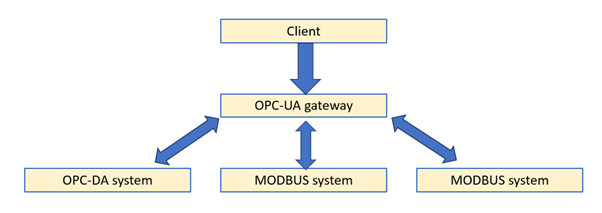
In India’s oil and gas industry, the storage and supply chain is currently automated using MODBUS and OPCDA protocols. And there are significantly fewer layers of security available in the protocols. With the increasing digitization and narrowing of the IT-OT gap, the MODBUS protocol needs to be upgraded with security layers. See the case study below:
Attackers gather information about the target’s supply chain, identifying key suppliers, software vendors, and third-party service providers. They analyze network and system architectures, looking for connections that rely on SCADA and MODBUS communications.
Attackers infiltrate less secure elements of the supply chain. This can include inserting malicious code into software updates. The malware performs predefined tasks such as opening backdoors, collecting sensitive data, or waiting for further commands. It can remain dormant until triggered externally, reducing the chance of detection.
Attackers can steal sensitive operational data, manipulate industrial processes, or lay the groundwork for a major disruption. Alternatively, attackers could use ransomware to lock down systems and demand payment to restore access.
The solution is to choose a more secure, more functional network such as OPCUA.
An OPCUA gateway adds a robust layer of security to existing MODBUS systems. By centralizing security management, it reduces the need for multiple upgrades to legacy systems, significantly reducing costs. The gateway enables secure, encrypted communications. Monitoring increases the overall network’s resilience to external threats. The gateway minimizes the risk of disruptions and breaches, providing cost-effective, long-term protection.
Um Ihnen einen besseren service GTEC verwendet cookies. Bitte Stimmen Sie unserer Verwendung von cookies.
Funktionale
Immer aktiv
Die technische Speicherung oder der Zugriff ist unbedingt notwendig für den legitimen Zweck der Ermöglichung der Nutzung eines bestimmten Dienstes auf ausdrücklichen Wunsch des Teilnehmers oder Nutzers oder der alleinige Zweck die Durchführung der übertragung einer Nachricht über ein elektronisches Kommunikationsnetz.
Preferences
The technical storage or access is necessary for the legitimate purpose of storing preferences that are not requested by the subscriber or user.
Statistik
The technical storage or access that is used exclusively for statistical purposes.Die technischen Speicherung oder dem Zugang, der verwendet wird, die ausschließlich für anonyme statistische Zwecke. Ohne eine Vorladung, der Freiwilligen Einhaltung der auf den Teil Ihres Internet-Service-Provider, oder zusätzliche Datensätze, die von Dritten Informationen gespeichert oder abgerufen werden, allein für diesen Zweck in der Regel nicht verwendet werden, Sie zu identifizieren.
Marketing
Die technische Speicherung oder der Zugriff ist erforderlich, um Benutzerprofile zu erstellen, um Werbung zu senden, oder zu verfolgen, dem Nutzer auf einer Internetseite oder über mehrere Internetseiten für ähnliche marketing Zwecke.